
A lot of estate planning and elder law attorneys are having the same private conversation right now.
They are experimenting with AI. They are using ChatGPT to draft a blog outline, clean up an email, brainstorm social media posts, summarize a complicated idea, or get through a marketing task they have been avoiding for three weeks. And honestly, I understand why. It is fast. It is available. It does not need a meeting. It does not forget the attachment. It does not tell you it is still waiting on someone from intake.
There is real usefulness there.
But then comes the part that makes attorneys uneasy.
The output sounds good.
It sounds confident.
It sounds like something that might be right.
And that is exactly where the danger begins.
Because in legal marketing, “sounds good” is not the standard. “Sounds confident” is not the standard. “Looks polished enough to publish” is absolutely not the standard.
The standard is whether the content is accurate, appropriate, ethical, specific to your audience, aligned with your firm’s value, and capable of helping the right prospect trust you enough to take the next step.
That is a very different bar.
And AI, left on its own, does not clear that bar just because it writes in complete sentences.
The Problem Is Not AI. The Problem Is Abdication.
I am not anti-AI. AI is already part of the marketing environment, and refusing to touch it is not a serious strategy. Used well, it can help a firm move faster, organize ideas, repurpose existing insight, and reduce some of the blank-page friction that keeps good marketing from happening at all.
The problem is not using AI.
The problem is using AI as if it has judgment.
That distinction matters.
AI can generate language. It can mimic structure. It can produce a very respectable-sounding paragraph about trusts, Medicaid planning, probate, asset protection, or the importance of updating your estate plan after a major life event. It can even sound warm and reassuring while doing it.
But it does not know your jurisdiction. It does not know your risk tolerance. It does not know what your bar would say about a particular claim. It does not know which clients you actually want more of. It does not know what your firm is trying to be known for. And it certainly does not know how to protect attorney value in a marketplace where prospects are already being trained to believe that legal documents are easy and professional judgment is optional.
That last part is the one I care about most.
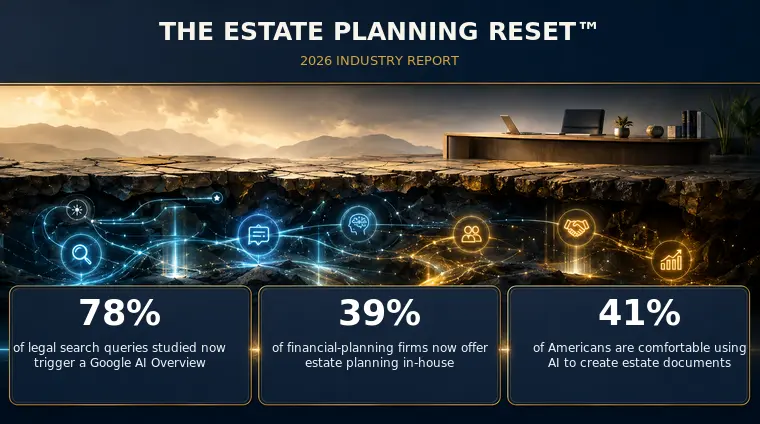
Because estate planning and elder law firms are already facing enough commoditization. DIY platforms, financial advisors with document tools, online form generators, and now AI-generated explanations are all pushing the same quiet message into the market: this is mostly paperwork.
You know that is not true.
Your best clients know that is not true after they have worked with you.
But your marketing has to make that truth visible before they hire you.
If AI-generated marketing makes your firm sound like every other firm, answers questions in the same generic way, and treats complex legal guidance as if it can be reduced to a few pleasant paragraphs, it does not defend your value. It weakens it.
Not dramatically. Not all at once.
Just enough to make you easier to overlook.
Polished Content Can Still Be Bad Marketing
One of the reasons AI is so seductive is that it fixes the surface problem quickly.
Before AI, bad marketing often looked bad. It was awkward. It was thin. It rambled. It sounded like someone copied a legal encyclopedia, removed half the useful parts, and called it a blog.
Now bad marketing can look much better.
That is not necessarily progress.
AI makes low-quality marketing sound polished, which means the risk is harder to spot. A blog post can be grammatically clean and still say nothing meaningful. A newsletter can feel professional and still fail to build trust. A landing page can be smooth and still attract the wrong client. A social media post can sound credible and still be too vague, too broad, or too generic to help a prospect choose you.
This is where a lot of firms get misled.
They assume the job of marketing content is to produce words. So if AI produces words quickly, they feel like they are gaining ground.
But the real job of marketing is not content production. The real job is decision support.
Your marketing should help a prospective client answer the questions they are already carrying, usually without saying them out loud.
Can I trust this firm?
Do they understand my situation?
Will they help me avoid a mistake?
Are they careful?
Are they experienced?
Will my family be safer because I hired them?
Is this the firm I should choose?
AI can help express answers to those questions. It cannot decide what those answers should be.
That requires judgment.
Attorney judgment and marketing judgment.
Both matter.
More Content Does Not Automatically Mean More Leads
Another false belief I see gaining speed is the idea that because AI can produce more content, firms should simply publish more.
More blogs. More social posts. More emails. More FAQs. More pages.
This is shortcut thinking dressed up as momentum.
In an AI-shaped search environment, generic content is not becoming more valuable. It is becoming more disposable. Search engines, AI summaries, and prospects themselves are swimming in basic explanations. Everyone can publish a post about “What Is a Revocable Trust?” Everyone can ask ChatGPT for “10 social media posts for estate planning attorneys.” Everyone can create a passable answer to a common question.
That means volume is not the advantage it used to look like.
The firms that win will not be the firms that publish the most AI-assisted content. They will be the firms whose marketing consistently signals better judgment, clearer standards, and stronger relevance to the people they are trying to reach.
This is the shift from being found to being chosen.
Being found still matters, of course. I am not suggesting you hide under a rock and wait for referrals to return to 2004 levels. Visibility matters. SEO matters. Local search matters. Your website matters.
But visibility alone does not solve the selection problem.
If a prospect finds five estate planning firms and all five sound basically the same, your visibility has only earned you a spot in the comparison set. It has not made you the safer choice.
AI can make that sameness worse if you let it.
Because AI is very good at producing language that is broadly acceptable, and broadly acceptable is often strategically useless.
Premium Firms Use AI With Standards
The firms that will handle this well are not the ones pretending AI does not exist.
They are also not the ones letting AI flood their marketing channels with cheap content because someone told them consistency is the whole game.
Premium firms will use AI as a tool, not an authority.
They will use it to support the process, not replace the thinking. They will keep attorney review in place. They will keep ethical awareness in place. They will keep specificity in place. They will keep the firm’s positioning and conversion strategy in place.
That means AI may help draft, but it does not get the final word.
It may help organize ideas, but it does not decide what matters.
It may suggest topics, but it does not determine the firm’s point of view.
It may save time, but it does not lower the standard.
That is the part many firms are missing. The point of AI in marketing should not be to make the firm sound like it has a content machine. The point should be to help the firm communicate its real value more clearly, more consistently, and more efficiently without sacrificing the very judgment clients are paying for.
For estate planning and elder law firms, this is not a small distinction.
Your clients are not buying documents. They are buying confidence. They are buying guidance. They are buying risk prevention. They are buying someone who can see what they cannot see, ask what they would not know to ask, and help them make decisions that protect the people they love.
Your marketing should reinforce that.
Not undermine it.
The Review Process Is Not a Bottleneck. It Is the Protection.
I know attorney review can feel like the slow part. Especially when everyone is excited about producing content faster.
But in legal marketing, review is not merely quality control. It is part of the value system.
When AI-assisted content goes public, it does not feel “AI-assisted” to the prospect. It feels like your firm said it. Your name is on it. Your standards are implied by it. Your reputation absorbs the risk.
So the question is not, “Can AI write this?”
The better question is, “Should this represent our firm?”
That question changes the conversation.
It forces you to look at whether the content is accurate enough, clear enough, differentiated enough, and useful enough to help a real prospect move closer to a confident decision. It also forces you to ask whether the content protects the dignity and value of the attorney-client relationship, or whether it quietly trains people to see your work as a set of interchangeable documents.
This is where marketing judgment matters just as much as legal review.
A technically accurate post can still be poor marketing. A compliant message can still be forgettable. A well-written article can still fail to convert because it never makes the prospect feel that your firm is the obvious, safer, more credible choice.
The goal is not simply to avoid mistakes.
The goal is to build trust.
AI Should Serve the Conversion Strategy
One of the clearest ways to evaluate AI-assisted marketing is to stop asking whether the content is “good” and start asking what job it is supposed to do.
Is it meant to help a prospect understand risk?
Is it meant to clarify why attorney guidance matters?
Is it meant to reduce anxiety before a consultation?
Is it meant to differentiate your firm from DIY options?
Is it meant to support SEO while still sounding like a real expert?
Is it meant to move someone from passive interest to inquiry?
If you cannot answer that, the content probably does not need to be published yet.
This is why AI without a conversion strategy creates so much noise. It produces assets, but not necessarily movement. It fills a calendar, but not necessarily a pipeline. It gives the appearance of marketing progress while the firm remains just as difficult to choose as it was before.
That is an expensive illusion.
And for firms that already feel unsure about whether their marketing is working, more noise is not the answer. More judgment is.
What Better Looks Like
Better does not mean your firm never uses AI.
Better means AI helps your marketing become clearer without making your firm sound cheaper.
It means your blog content reflects the questions and fears your actual clients bring into consultations. It means your website does not just explain services, but helps prospects understand why choosing the right attorney matters. It means your emails sound like they came from a firm with standards, not from a content generator with a legal vocabulary. It means your follow-up reinforces trust instead of chasing people with generic reminders.
Better means the human judgment stays visible.
Because that is what prospects are ultimately looking for, even when they do not have the language to say it. They are looking for someone who feels careful, credible, experienced, and safe. They are looking for a firm that does not make a serious decision feel casual.
AI can help you communicate that.
It cannot become that.
The Decision for This Quarter
The question for estate planning and elder law firms is not whether AI belongs in marketing.
It does.
The question is whether AI is being used inside a disciplined system of standards, review, positioning, and conversion strategy — or whether it is quietly becoming the system.
That is the line.
On one side, AI helps your firm communicate more clearly and consistently.
On the other, it makes you sound polished, generic, and easier to compare.
And comparison is where premium value goes to die.
If your firm is trying to grow in 2026, this is not the moment to chase content volume for its own sake. It is the moment to ask whether your marketing is protecting what makes your firm worth choosing.
That is exactly what we are unpacking in our live webinar, Is ChatGPT Lying to You? (It Sounds So Convincing), on June 25.
We will talk about where AI helps, where it creates risk, and how estate planning and elder law firms should use AI-assisted marketing without weakening trust, rankings, ethics awareness, or attorney value.
If you are using AI, considering it, or wondering whether your competitors are getting ahead while you are trying not to make a very expensive mistake, this is the conversation to join.
Frequently Asked Questions
1. Should estate planning and elder law firms avoid AI in marketing altogether?
No. AI can be genuinely useful when it is used to support a thoughtful marketing process. The risk is not the tool itself. The risk is using AI-generated content without attorney review, marketing judgment, ethical awareness, and a clear strategy for helping the firm get chosen.
2. Can ChatGPT create accurate legal marketing content?
It can create content that sounds accurate, and sometimes the content may be directionally useful. However, legal marketing requires more than plausible language. It requires review for accuracy, jurisdictional sensitivity, ethical considerations, firm positioning, and whether the message is appropriate for the audience and offer.
3. Will publishing more AI-generated content improve SEO?
Not automatically. More content does not equal better rankings or better leads, especially when the content is generic. In an AI-shaped search environment, firms need content that demonstrates relevance, experience, clarity, and trust. Publishing more interchangeable content can make a firm easier to overlook.
4. How should a law firm safely use AI in its marketing process?
AI should be used as a drafting, organizing, or repurposing tool under human direction. The firm should maintain clear standards for attorney review, message quality, audience fit, and conversion purpose. AI should never be treated as the final authority on legal accuracy, ethics, or strategic positioning.
5. Why is generic AI content a problem for premium firms?
Premium firms need marketing that reinforces expertise, judgment, and trust. Generic AI content often smooths away the very specificity that helps a prospect understand why one firm is safer or more credible than another. If the marketing sounds interchangeable, the firm becomes easier to compare on price or convenience.
6. What should we look at first if we are already using AI in our marketing?
Start by reviewing whether your AI-assisted content helps your firm get chosen, not merely seen. Look at whether it reflects your standards, protects attorney value, speaks to real client concerns, and guides prospects toward a confident next step. If it only fills space, it is not doing enough.