
In more than thirty years of helping estate attorneys grow their practices, I’ve watched the ground move under this profession only a handful of times. It’s moving again — and this time it’s moving fast. That’s why I wrote the industry report, The Estate Planning Reset™, and if you are an estate planning or elder law attorney, I wrote it for you.
Here’s why.
Client acquisition in estate planning and elder law hasn’t just changed. It has been fundamentally reordered. In more than three decades in this work, I’ve learned to recognize a shift of this size, because I’ve lived through it before. Twice.
The first was the federal estate tax exemption. Remember when it was $600,000? Back when you could show the value of estate planning by the federal estate tax savings — when the whole consultation was charts and graphs and software projections built around that one number? Then the exemption climbed, and climbed, and for 2026 it sits at $15 million per person, $30 million for a married couple. The vast majority of people will now never owe a dollar of federal estate tax. That single change rewrote everything: the message, the consultation, the intake, and most of those charts and graphs are mostly gone.
The second was the internet. Websites, social media, Google ads. I remember practices that grew for decades without a single one of them in the mix. Now, if most of your new business isn’t coming from online sources, you’re leaving a fortune on the table. That shift rewrote the message, the intake, the sales process, and how the whole operation runs behind the scenes.
And here we are at the third. Artificial intelligence. This one isn’t just about AI-powered search. It’s everything AI has driven over the past two years, all at once: how people find an attorney, how they decide, what they already believe before they ever call. The technology moved, and the entire game moved with it.
So I did what I’ve always done when the ground shifts. I went and studied it — force by force — and I wrote down what I found.
Here is some of what the research surfaced. Every figure is traced to its primary source.
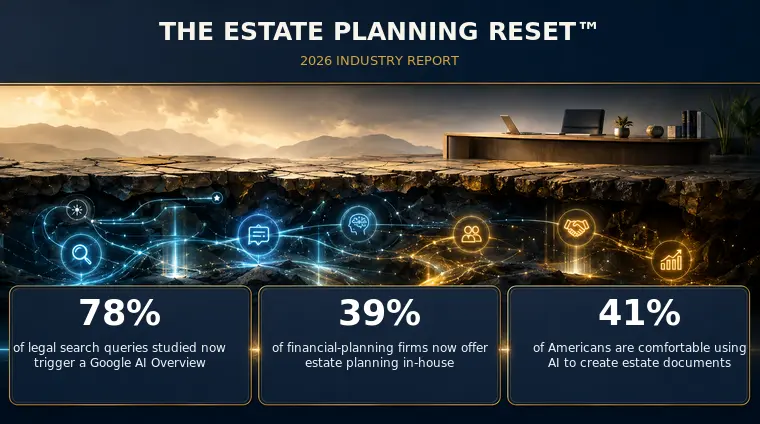
The front door moved. Seventy-eight percent of legal search queries studied now trigger a Google AI Overview — the highest of any high-stakes category (SE Ranking). Now, when that summary appears, users click a traditional result only about half as often: eight percent versus 15 (Pew Research Center). A firm can hold its rankings and still lose the traffic behind them.
The referral channel is being absorbed. Thirty-nine percent of financial-planning firms now offer estate planning in-house (WealthManagement.com, RIA Edge 2026), and a wave of white-label software equips non-attorneys to generate documents under their own brand. The most trusted client source in estate planning is quietly being unbundled.
The prospect who does arrive is a different person. Roughly 41 percent of Americans are now comfortable using AI to help create estate documents (Trust & Will, 2026). That number is even higher among younger generations.
The leads that do come in often die on arrival. Twenty-six percent of law firms never respond to an online inquiry, and the median response time is 13 minutes (Hennessey Digital). The typical firm, with the typical response, converts only about 14 percent of inquiries. Meanwhile, firms that get this right are converting 40 to 50 percent (Clio Legal Trends).
The gap is not lead quality. It is what happens after the lead arrives.
Read together, these are not separate problems. They are one story told from several directions — a reordering of the rules themselves, not a downturn to wait out. The report names ten connected forces across client acquisition, conversion, and operations.
Read the full report — all ten forces, fully sourced — at IMSRocks.com/estate-planning-reset.
From Naming It to Fixing It
Naming what changed is the first move. Deciding what to rebuild, and in what order, is the harder one — and it is not work a report can finish for you.
That is the purpose of The Great Shake-Out, Estate Planning & Elder Law Growth Summit — October 12–14, 2026, in Colorado Springs. Three working days built to help firms diagnose where they actually stand across acquisition, conversion, and operations, and leave with a sequenced plan rather than a longer list of things to worry about. Seating is limited.
Registration and details: EstatePlanningReset.com.