
For thirty-one years, I’ve helped estate planning and elder law firms grow. In that time I’ve watched a lot of trends come and go, and I’ve learned to tell the difference between a fad and a floor shifting under our feet. What’s happening right now is the floor.
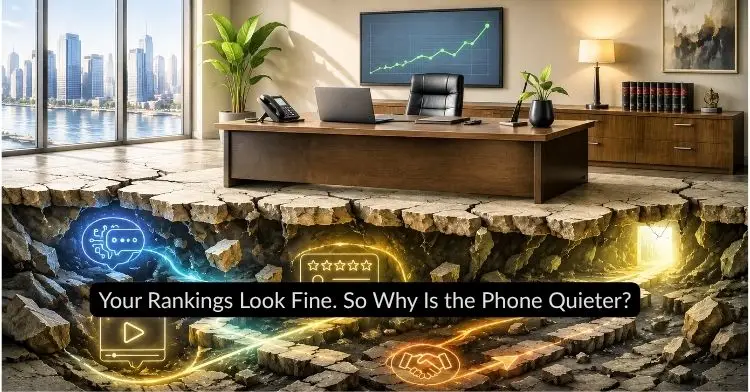
The way American families find and hire an estate planning attorney is changing faster than most firms can adapt. And the hardest part — the part that keeps good owners stuck — is that the dashboard still looks fine while it happens. Rankings hold. The website looks the same as it did last year. But the phone just gets a little quieter every month, with no obvious reason why.
Let me walk through what’s actually going on, because once you see the mechanism, the fix stops feeling like guesswork.
The search your prospects run doesn’t end on your website anymore
For twenty years, the deal was simple: someone typed “what does a living trust do” into Google, clicked one of the top results, and — if you’d done your SEO homework — that result was you. They landed on your page, read your explainer, and a lot of them picked up the phone.
That chain is breaking at the first link. Today, when someone asks Google an estate planning question, Google increasingly answers it right there, in an AI-generated summary at the top of the page. The searcher gets what they came for and never scrolls to a law firm’s website at all.
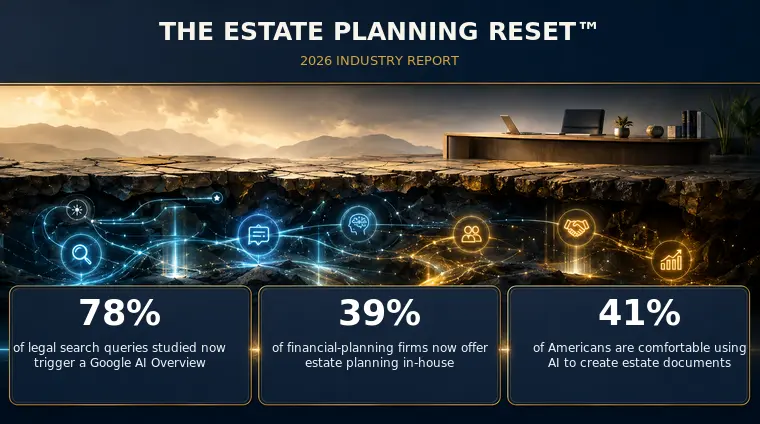
This isn’t a hunch. In SE Ranking’s study of legal search queries, nearly 78% triggered a Google AI Overview — the highest rate among the high-stakes categories they examined. And when those summaries appear, people stop clicking: a Pew Research Center analysis of real browsing behavior found users clicked a traditional search result in just 8% of visits when an AI summary was shown, versus 15% when it wasn’t — roughly half as often. Gartner has projected that traditional search volume will fall 25% in 2026 as AI tools absorb these queries.
Here’s the piece that makes it sneaky: your ranking can be completely unaffected while your traffic quietly falls. You’re still #1 for the phrase. Fewer people are even seeing that list. That’s why the dashboard lies.
The referral pipeline is drying up at the same time
If it were only search, that would be a big enough problem. But the second channel most estate planning firms lean on — referrals from financial advisors and CPAs — is shifting underneath us too.
Advisors are increasingly keeping estate planning in-house rather than sending clients to an attorney. A WealthManagement.com survey found that 39% of financial planning firms now offer trust and estate planning internally, and more than half of those plan to expand the service this year. AI-powered platforms like Wealth.com, Vanilla, Trust & Will, and Snug are handing advisors the tools to support estate planning conversations and document workflows without referring to a lawyer — Trust & Will alone reports more than 20,000 financial advisors on its platform.
I’m not telling you this to alarm you. I’m telling you because when both of your primary channels soften in the same eighteen months, it doesn’t feel like two problems. It feels like one vague, creeping “we’re just slower than we used to be.” And a vague problem is one you can’t fix, because you can’t name it.
What this means for the prospect who does still call
The families who reach you now are different from the ones you’re used to. They’ve already run their questions through an AI assistant. They’ve already read a summary of how a trust works. Many of them have already priced a DIY option. By the time they call your office, they arrive pre-informed, more skeptical, and more price-sensitive than the clients you built your practice on.
Across our work with more than 150 estate planning and elder law firms, I’m seeing the same pattern everywhere: client acquisition now depends far less on being found once and far more on building trust across several touch points before a prospect ever schedules a consultation.
The old model was: be visible, and the visible get chosen. The new model is: be visible and be trusted before the first conversation — because the first conversation now happens on your website, your YouTube channel, and your reviews, long before it happens on the phone.
The mistake I don’t want you to make
The most common reaction I see is the most understandable one: traffic is down, so owners conclude they have a traffic problem and go chasing traffic. They switch SEO vendors. They buy more ads. They try to win back visits that have permanently migrated somewhere else.
That’s trying to solve a 2026 problem with a 2024 playbook. The categories we all used to diagnose a struggling firm — “we need more leads,” “we need better rankings” — don’t map cleanly onto what’s actually breaking. And if you measure the wrong thing, you’ll fix the wrong thing, and the phone stays quiet.
The firms navigating this well are doing three things differently:
- Becoming a source the AI cites, not just a page that ranks — restructuring their content so they show up inside the answer, not below it.
- Building trust surfaces — especially video — that a skeptical, pre-advised prospect can use to vet them before ever making contact.
- Treating search and referral decline as one connected problem, and rebuilding client acquisition as a coordinated system instead of a pile of disconnected tactics.
None of that requires panic. It requires a new diagnosis.
Where we’re taking this next
This shift — I’ve started calling it the Great Shake-Out — is the whole reason we’re convening a working summit this fall. The Great Shake-Out Growth Summit runs October 12–14 in Colorado Springs, and it’s built for estate planning and elder law firm owners who’d rather get ahead of this than wait it out. Three days, three domains — client acquisition, conversion, and operations — and you leave with a prioritized roadmap for your own firm, not a binder of theory.
If you take one thing from this post, let it be this: the quiet phone is not a mystery, and it’s not your fault. It’s a changed market wearing a disguise. The firms that name it correctly will find the field wide open. The ones that keep chasing the old numbers will get shaken out.
You can’t coast anymore — but you can absolutely adapt. That’s the whole point.