
A lot of firms are looking at their marketing right now and feeling a very specific kind of frustration.
They are not invisible. Not exactly.
Their website still gets traffic. Their Google Business Profile still gets views. Their ads may still be producing clicks. Their newsletter is going out. Their social posts are being seen by someone, somewhere. The dashboard has enough activity on it to suggest that marketing is “working,” at least in the narrowest technical sense of the word.
And yet the phone is not ringing the way it should.
The consultation calendar does not feel predictable. The leads that do come in feel colder, more hesitant, more price-sensitive, or less ready to choose. The firm is getting attention, but that attention is not reliably turning into trust, and trust is the part that actually matters when someone is deciding who should handle their estate plan, elder law issue, Medicaid planning, probate matter, or family transition.
That gap between attention and action is what I call the conversion gap.
And it is becoming one of the most important problems in estate planning and elder law marketing.
For years, firms were taught to think about marketing in a fairly linear way. Get found. Get traffic. Get leads. Get consultations. Get clients. There was always more nuance than that, of course, but the basic mental model was simple enough. If you could increase visibility, you could usually expect some improvement in opportunity.
That model is not gone, but it is no longer sufficient.
Visibility still matters. I will say that plainly because I do not want anyone overcorrecting into nonsense. You cannot be chosen if no one can find you. But being found is no longer the same thing as being preferred. It is not even the same thing as being meaningfully considered.
That is the uncomfortable shift.
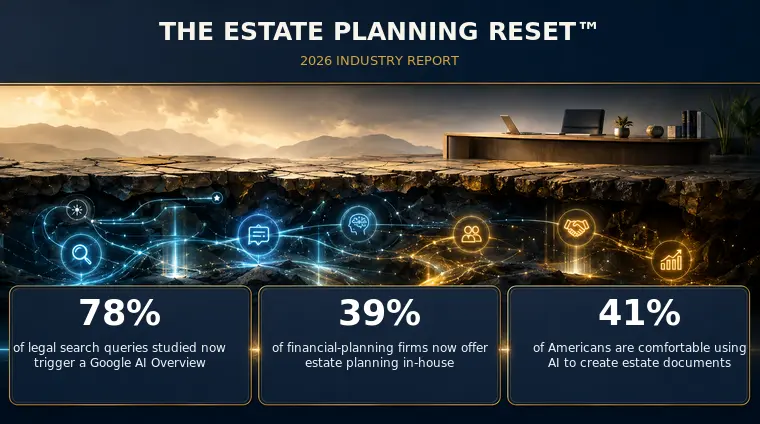
Prospects today are arriving with more information than ever, but not necessarily more confidence. They have read AI summaries, skimmed websites, compared reviews, asked a financial advisor, talked to a friend, glanced at legal templates, and maybe even asked ChatGPT what they “need.” By the time they land on your site, they may know more vocabulary than they used to, but that does not mean they know what matters.
In fact, it often means the opposite.
They are carrying more fragments, more assumptions, more half-answers, and more uncertainty. And when a prospect is uncertain, they do not automatically choose the firm with the most information. They choose the firm that feels safest, clearest, and most capable of guiding them through the decision.
That is where many firms are losing the consultation.
Not because they are bad attorneys. Not because their SEO is worthless. Not because marketing suddenly stopped working. They are losing because their marketing is still designed to create attention, while the prospect is looking for decision confidence.
There is a difference.
Attention says, “I see you.”
Trust says, “I believe you can help me.”
Decision confidence says, “I am ready to take the next step with you.”
Most law firm marketing stops somewhere between the first and second.
This is why traffic can go up while consultations stay flat. It is why ads can generate clicks without producing serious inquiries. It is why a firm can have a decent-looking website and still feel strangely interchangeable. It is why prospects who should be a strong fit still hesitate, shop around, ask about price too early, or disappear after the first interaction.
The problem is not always reach. Often, the problem is that the firm’s digital presence does not carry enough judgment.
And yes, judgment is the word I mean.
In estate planning and elder law, prospects are not simply buying documents. They are buying protection, clarity, confidence, and the feeling that someone competent is helping them avoid a painful mistake. The documents matter, obviously. But the reason they hire an attorney instead of clicking around on a DIY platform is not because the attorney can type words into a template. It is because the attorney knows what should happen, what should not happen, what the family has not thought through, and where the risk is hiding.
That is attorney value.
The problem is that many firms do not communicate that value clearly online.
They explain what a will is. They explain what a trust is. They explain probate. They explain Medicaid planning. They explain powers of attorney. They explain and explain and explain.
There is nothing wrong with education. Education has a place. But basic explanation has become cheap. AI can summarize basics all day long. Your competitors can publish the same general articles. Legal directories can explain the same definitions. A prospect can get a plain-English overview of almost anything in ten seconds.
So if your marketing is built mostly around explaining the basics, you are competing in the most crowded and least valuable part of the decision.
That is not where premium firms win.
Premium firms win by helping prospects understand what matters, what risks they should be paying attention to, what tradeoffs exist, and why choosing the right professional is not the same thing as finding the cheapest document path.
They do not just provide information. They create orientation.
That is the missing layer in a lot of marketing systems.
A prospect lands on the website and sees the expected pages. Estate planning. Trusts. Wills. Probate. Elder law. Medicaid. Maybe a warm photo. Maybe some credentials. Maybe a few testimonials. Maybe a button that says “Schedule a Consultation.”
Fine. Necessary. Not enough.
The real question is whether the experience makes the prospect feel, “This firm understands my situation, knows how to guide me, and is the safer choice.”
If the answer is no, the prospect keeps comparing.
And when prospects keep comparing, they tend to compare the easiest thing to understand: price.
That is why a conversion problem often shows up as a pricing problem. The firm thinks, “People are just shopping around.” Sometimes they are. But often, the marketing has not given them a better basis for decision-making. When your value is not clear, price becomes the organizing factor.
That is not the prospect being unreasonable. That is the market doing what markets do when options look similar.
This is especially true now because AI has made sameness easier to produce. A firm can generate a blog post, social caption, FAQ, or service page in a few minutes. So can everyone else. The result is a growing sea of content that sounds polished enough but carries very little actual point of view.
Prospects may not be able to diagnose that consciously, but they can feel it.
They feel when a website is generic. They feel when the language could belong to any firm in any city. They feel when the message is technically correct but not especially reassuring. They feel when the firm is present but not distinct.
And in a high-trust category, that feeling matters.
The conversion gap is not usually solved by adding another tactic on top of the pile. More ads will not fix unclear positioning. More traffic will not fix weak trust signals. More blog posts will not fix a website that does not communicate judgment. More automation will not fix a follow-up experience that feels disconnected from the seriousness of the decision.
This is where firms get into trouble. They sense that something is not working, so they do more. More content. More platforms. More campaigns. More vendor conversations. More ideas from more people who all have a favorite tactic.
It creates motion, but not necessarily momentum.
The better question is not, “How do we get more attention?”
The better question is, “Where are prospects losing confidence before they contact us?”
That question changes the work.
Now you are looking at the website differently. You are not asking whether the page exists. You are asking whether it helps the visitor understand why your firm is the right choice for the problem they are actually trying to solve.
You are looking at your messaging differently. You are not asking whether it sounds professional. You are asking whether it communicates focus, standards, and judgment.
You are looking at your follow-up differently. You are not asking whether an email was sent. You are asking whether each touchpoint reduces uncertainty and makes the next step feel natural.
You are looking at SEO differently. You are not just asking whether you rank. You are asking whether the search experience leads into a digital presence that builds trust once attention is earned.
That is the shift premium firms have to make.
They have to stop treating marketing as a visibility machine and start treating it as a decision-confidence system.
A decision-confidence system does not mean complicated. In fact, it usually means the opposite. It means the firm’s digital presence is coherent. The website, messaging, content, lead capture, intake, and follow-up all reinforce the same basic impression: “We understand this. We know how to guide you. Here is the next right step.”
That sounds simple. It is not always easy.
It requires restraint. It requires saying no to generic content just because it is easy to produce. It requires resisting the temptation to chase every new platform or every vendor promise. It requires looking honestly at whether your marketing reflects the quality of your legal work, or whether it quietly makes you look like one more option in a crowded market.
And this is where I will be a little blunt, because I think it is useful.
If your firm is premium, but your marketing looks interchangeable, your prospect is getting mixed signals.
You may know the work is better. Your clients may know it after they hire you. Your referral sources may know it because they have experienced your judgment. But a new prospect coming through search, AI-assisted discovery, or a paid ad does not know that yet.
They only know what your digital presence helps them believe.
This is why conversion is not just a technical issue. It is a trust issue.
Yes, page speed matters. Calls to action matter. Forms matter. Mobile experience matters. Scheduling friction matters. All of that is real, and it should be handled well. But those mechanics sit underneath a larger question: does the prospect believe taking the next step with you is worth it?
If they do not, a prettier button will not save the system.
The firms that will win in this next phase are not necessarily the loudest firms. They are not the firms publishing the most. They are not the firms with the cleverest AI prompts or the biggest stack of disconnected tools.
The firms winning now are clearer.
They are clear about who they serve. Clear about why their work matters. Clear about the risks prospects are trying to avoid. Clear about what makes attorney judgment different from generic information. Clear about the next step.
That clarity is what turns attention into trust.
And trust is what turns a website visitor into a consultation.
At IMS, this is the work we believe estate planning and elder law firms need to take seriously now. Not panic. Not chase every shiny object. Not declare that SEO is dead or that AI is replacing attorneys or that marketing does not work anymore. That is all too dramatic, and usually not very useful.
The real issue is more practical.
Your prospects are more informed, but not more certain. Your competitors are more visible, but not necessarily more trusted. Your marketing may be creating attention, but not enough confidence to make your firm the obvious choice.
That is fixable, but it is not fixed by volume alone.
It is fixed by building a coherent marketing system that helps the right prospects move from awareness to belief to action. It is fixed by making your judgment visible before the consultation. It is fixed by aligning your website, messaging, SEO, content, and follow-up around the decision your prospect is actually trying to make.
Because the goal is not simply to be seen.
The goal is to be chosen.
And if you want the practical framework first, download the From Invisible to In-Demand Playbook and use it to evaluate whether your current marketing is building real decision confidence or simply generating activity.
Frequently Asked Questions
1. Why are we getting website traffic but not enough consultations?
Traffic alone does not mean prospects are confident enough to act. If your website creates awareness but does not clearly communicate trust, judgment, and fit, visitors may continue comparing other firms instead of booking a consultation. The issue is often not attention. It is the lack of decision confidence after attention is earned.
2. Does this mean SEO is no longer important for estate planning and elder law firms?
No. SEO still matters because prospects need to find you before they can choose you. The problem is treating SEO as the entire solution. In today’s search environment, visibility has to connect to stronger positioning, clearer messaging, and a website experience that makes the firm feel credible and distinct.
3. How has AI changed law firm marketing?
AI has made basic information easier to access and easier to produce. That means generic educational content no longer differentiates a firm the way it once did. Prospects can get simple explanations almost anywhere. What they still need from an attorney is judgment, guidance, and confidence about what applies to their specific situation.
4. Why do prospects compare attorneys on price?
Prospects often compare on price when they do not have a clearer way to understand value. If several firms look and sound similar online, price becomes the easiest point of comparison. Strong marketing should help prospects understand why attorney judgment, process, standards, and fit matter more than simply finding the cheapest option.
5. What should a firm fix first if attention is not turning into consultations?
Start by looking at the points where confidence may be breaking down. Review whether your website clearly communicates who you serve, what risks you help clients avoid, why your judgment matters, and what the next step should be. Then look at whether your follow-up reinforces that same confidence or leaves prospects to keep comparing.
6. Can better marketing help us protect premium fees?
Yes, when marketing clearly communicates value before the consultation. Premium fees are harder to defend when a firm looks interchangeable. A coherent marketing system helps prospects understand why the firm is a safer, clearer, more capable choice, which reduces price sensitivity and supports stronger positioning.