
There is a particular kind of frustration I hear from estate planning and elder law attorneys that is becoming much more common.
The firm is doing marketing. The website is live. SEO work is happening. Articles are being published. Someone is posting on social media. There may be paid advertising running in the background, and the analytics reports show impressions, clicks, rankings, visitors, and enough other numbers to make everyone feel as though something should be happening.
And yet, the owner-attorney still has the uncomfortable sense that the marketing is not producing the confidence it should.
The firm is visible, at least according to the reports, but the phones are not ringing with the frequency or quality expected. Prospects still seem to be comparing several firms. Consultations do not always turn into engagements. Referrals continue to carry more of the growth burden than anyone would like to admit.
This is usually where the conversation starts drifting toward tactics. Should we publish more? Increase the ad budget? Change the keywords? Add video? Start posting somewhere else?
Those may be reasonable questions later. They are not the first question I would ask.
The first question is much less comfortable: When prospective clients encounter your firm online, does your marketing make you feel like the obvious choice, or merely one more acceptable option?
Visibility Has Become Easier to Create—and Less Valuable by Itself
For a long time, law firm marketing was largely treated as a visibility problem. The objective was to appear when someone searched, maintain a professional website, stay active enough to look credible, and make it relatively easy for a prospect to contact the firm.
That foundation still matters. You cannot be chosen if no one can find you.
But visibility has become much easier to manufacture. Websites are easier to build. Content is easier to produce. Advertising platforms make it possible for almost any firm to appear in front of a local audience. AI can generate a passable article, social post, or practice-area explanation in seconds.
As a result, the basic signals that once helped a firm stand out now make a firm look merely competent.
Most firms have a professional-looking website. Most say they are experienced, compassionate, and committed to personalized service. Most explain trusts, wills, Medicaid planning, probate, and powers of attorney in roughly the same language. Many appear in the same search results, beside competitors making nearly identical claims.
That is generic visibility. It proves that the firm exists, but it does not give the prospective client a compelling reason to prefer it.
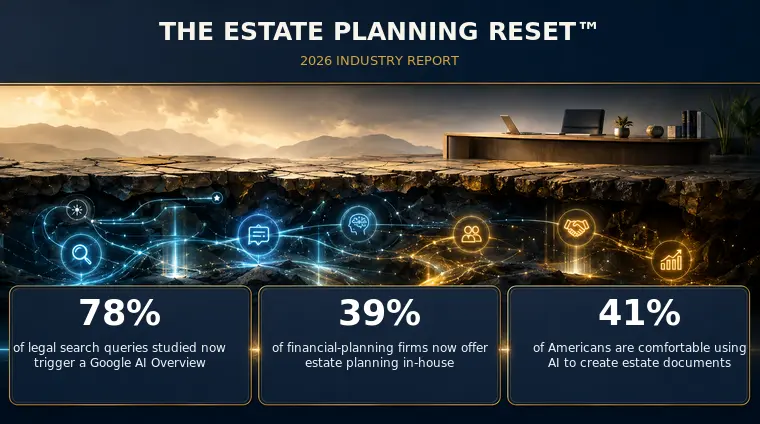
In an AI-shaped search environment, that weakness becomes more significant because the first stages of research are happening faster. Prospects may receive an AI-generated overview before they visit a law firm’s website. They may scan a map listing, read a few reviews, open two or three sites, and form an impression in a matter of minutes.
They are gathering information quickly, but they are still looking for confidence.
The firm that wins is rarely the one that supplies the most information. It is the one whose entire digital presence makes the decision feel safer.
The Real Problem Is Usually Not a Lack of Activity
When marketing is underperforming, the instinct is often to add something.
Add another campaign. Add another content format. Add another platform. Add another vendor with a specialized solution for one isolated part of the problem.
This is how otherwise sophisticated firms end up with piecemeal marketing.
The website was built by one company. SEO is handled by another. Advertising is managed somewhere else. A staff member posts on social media when there is time. Email follow-up lives in a separate system, assuming there is a meaningful follow-up process at all.
Each piece may be functioning. The website loads. The ads receive clicks. The articles are indexed. The email is delivered.
But the prospect does not experience those pieces separately. The prospect experiences the firm as one continuous impression.
When those pieces do not reinforce one another, the decision path begins to break down. The advertisement creates one expectation, the website communicates another, the content sounds generic, the consultation request feels transactional, and the follow-up does little to restore confidence.
Nothing is necessarily terrible. It is simply disconnected.
That distinction matters because disconnected marketing often creates the appearance of momentum without building much actual preference. The firm becomes easier to find, but not easier to choose.
Prospects Are Looking for Evidence of Judgment
Estate planning and elder law clients are not shopping for a document in the way they shop for a household product, even when low-cost platforms and automated tools encourage them to think that way.
They are trying to decide whom they can trust with decisions involving their money, their family, their independence, their business, their health, and eventually their death.
That is not a casual purchase.
The prospect may begin with a practical question about a trust or a Medicaid application, but underneath that question is a more emotional concern: “How do I know this will be handled correctly?”
Your marketing has to answer that concern before the prospect has enough confidence to call.
That answer does not come from repeatedly declaring that the firm is knowledgeable. It comes from demonstrating judgment across the entire digital experience.
A strong website does more than list services. It helps the prospect understand which issues matter, why the situation may be more complicated than it appears, and how the firm approaches those decisions.
Strong content does more than provide definitions. It reveals the attorney’s ability to recognize risk, explain tradeoffs, and guide someone through uncertainty.
Strong follow-up does more than remind a lead that the firm exists. It reinforces professionalism, responsiveness, and the sense that there is a thoughtful process behind the engagement.
These are selection signals. They reduce perceived risk, and reducing perceived risk is what moves a prospect from browsing to choosing.
The Most Expensive Marketing Problem Is Looking Interchangeable
When several firms appear equally qualified, the prospect has to find another way to decide.
Sometimes that means choosing the firm with the most reviews. Sometimes it means choosing the first firm that calls back. Sometimes it means selecting the least expensive option, the most convenient appointment, or the lawyer recommended by an advisor.
This is what happens when marketing creates awareness without establishing preference. The prospect is left to compare firms using whatever visible differences remain.
That is a dangerous place for a premium law firm to compete.
You may have deeper experience. You may provide more thoughtful counsel. You may spend more time understanding family dynamics, tax exposure, long-term care risks, or the practical consequences of a poorly coordinated plan.
Prospects do not choose the best firm in some objective sense. They choose the firm that gives them the clearest and most credible evidence that it is the best choice for their situation.
This is why generic visibility can be so deceptive. It can make a firm feel as though it is competing effectively while the most important part of the decision is being lost.
A Connected Marketing System Builds Confidence in Sequence
Effective marketing for an estate planning or elder law firm should not feel like a collection of promotional activities. It should feel like a coherent path from initial awareness to confident action.
A prospect first becomes aware of the firm through search, advertising, a referral, an article, a webinar, or a social post. What they encounter next should deepen the same impression rather than restart the conversation.
The website should immediately clarify whom the firm serves and why its approach matters. The content should reinforce experience and judgment. Reviews and other trust signals should support the firm’s claims. The invitation to take the next step should feel clear and appropriate. Follow-up should continue reducing uncertainty instead of simply asking whether the person is ready to schedule.
Each touchpoint has a different job, but all of them should move the prospect in the same direction.
This is where many firms lose the advantage they believe they have. They are investing in several marketing components, but those components were never designed to function as one decision system.
The SEO company is trying to increase traffic. The advertising manager is trying to lower the cost per lead. The content writer is trying to publish on schedule. The website is trying to represent every service the firm offers. The intake team is trying to respond quickly.
Everyone may be doing exactly what they were hired to do, while no one is responsible for the central outcome: making the firm easier to trust and choose.
That is the difference between marketing activity and marketing infrastructure.
AI Makes the Foundation More Important, Not Less
There is understandable anxiety among attorneys about how AI may influence recommendations, search visibility, and consumer behavior. Some firms are already being approached with new tools, new optimization services, and new promises about how to appear in AI-generated answers.
I would be very cautious about allowing that anxiety to become another round of disconnected activity.
No marketing company can responsibly guarantee that an AI platform will recommend a particular firm. The technology, platforms, and search experiences will continue to change.
What firms can control is the strength and coherence of the signals available to both people and systems.
Is the firm’s focus clear? Is its expertise demonstrated consistently? Does its content provide meaningful insight rather than generic explanations? Does the website communicate professionalism and authority? Do third-party signals reinforce credibility? Is there a logical path from discovery to engagement?
AI-shaped search raises the importance of those questions because it compresses the evaluation process. Firms have less time to communicate relevance, and generic information is easier than ever to summarize or replace.
The response is not to chase every new AI tactic. It is to make the foundation stronger, clearer, and more connected.
The Question Your Firm Should Be Asking
The useful question is no longer simply, “Are we visible?”
A better question is, “Does everything a prospect sees make it easier for that person to choose us?”
That question changes how you evaluate marketing.
You stop judging the website only by its appearance. You ask whether it communicates a compelling reason to prefer the firm.
You stop judging content only by traffic. You ask whether it demonstrates the kind of judgment a high-value client is trying to find.
You stop judging campaigns only by lead volume. You ask whether the leads arrive with greater confidence, clearer expectations, and a stronger understanding of why the firm is different.
You also begin to see why adding more activity to a disconnected system rarely solves the underlying problem. More visibility simply sends more people into the same uncertain decision path.
The firms that will grow most reliably in this environment will not necessarily be the firms that publish the most, spend the most, or appear on the greatest number of platforms. They will be the firms whose marketing consistently reduces uncertainty and makes the choice feel increasingly obvious.
That requires more than isolated SEO, content, advertising, or website work. It requires a connected system built around the way real people evaluate trust.
From Visible to Genuinely In-Demand
On July 23, we are hosting our live webinar, From Invisible to In-Demand, where we will examine how AI-shaped search is changing the way estate planning and elder law firms are discovered, evaluated, and selected.
We will talk about why some firms remain overlooked even when their marketing appears active, how disconnected marketing weakens the signals prospects use to make decisions, and what must be true for your digital presence to turn attention into confidence.
This is not a webinar about AI hacks, platform tricks, or finding one more tactic to add to an already crowded marketing plan. It is about understanding the difference between being visible and becoming the firm a prospect feels ready to hire.
Register for the July 23 Why AI Recommends Some Lawyers and Maybe Not You webinar and learn how to build a clearer path from being found to being chosen.
For firms that want to begin evaluating that path now, the From Invisible to In-Demand Playbook provides a practical framework for identifying where visibility, trust, and selection may be breaking down.
Frequently Asked Questions
1. Is visibility still important for estate planning and elder law firms?
Yes. Visibility remains essential because a prospect cannot evaluate or choose a firm they never encounter. The problem arises when firms treat visibility as the final objective rather than the first stage of the decision process. Search rankings, advertising, and content should create discovery, but the rest of the firm’s digital presence must convert that discovery into trust and confidence.
2. How can a firm be visible online and still be overlooked?
A firm can appear in search results, publish regularly, and receive website traffic while still looking similar to every other option. When the messaging is generic, the content provides little evidence of judgment, or the digital experience feels disconnected, prospects have no strong reason to prefer that firm. Visibility creates consideration, but clear and consistent trust signals create selection.
3. Does AI mean traditional estate planning SEO no longer works?
No. SEO remains an important part of being discovered, particularly for local and high-intent searches. What has changed is that SEO cannot carry the entire decision by itself. AI summaries, map listings, reviews, website messaging, content quality, and follow-up all influence how a prospect evaluates the firm. SEO works best when it is part of a connected marketing system rather than an isolated traffic strategy.
4. What are the signs that our marketing is too piecemeal?
Common signs include different vendors working toward unrelated goals, inconsistent messaging across ads and website pages, content that does not reflect the firm’s real point of view, weak or delayed lead follow-up, and reports that show activity without explaining whether better prospects are choosing the firm. The clearest sign is that the owner cannot explain how the individual marketing pieces work together to move someone from awareness to engagement.
5. Should we increase our marketing activity if inquiries are low?
Not automatically. Increasing activity can help when the underlying decision path is already clear and credible. When the foundation is weak or disconnected, however, more activity often increases spend without improving conversion. Before adding another campaign or platform, determine whether the current marketing gives prospects a persuasive reason to trust the firm and a clear next step.
6. What makes a law firm feel like the obvious choice?
The obvious choice is usually the firm that reduces uncertainty most effectively. Its digital presence clearly communicates whom it serves, demonstrates experience through useful judgment, reinforces credibility across multiple touchpoints, and makes the next step feel safe and straightforward. No single website statement or marketing tactic creates that outcome. It is produced by a coherent system that consistently helps the prospect feel confident in the decision.