
After our recent webinar, Is ChatGPT Lying to You?, I found myself thinking about one of the more uncomfortable truths sitting underneath the whole AI conversation.
Most attorneys are not afraid of AI because they think it is useless. They are afraid of AI because it is useful enough to be tempting, polished enough to be believable, and unreliable enough to make them nervous.
That is a very particular kind of problem.
If a tool is obviously bad, you stop using it. If a tool is obviously brilliant, you build around it. But AI lives in that strange middle territory where it can produce something that looks finished, sounds confident, and still needs a responsible adult in the room. Preferably several.
For estate planning and elder law firms, this matters because your marketing is not just “content.” It is part of how prospective clients decide whether you feel credible, careful, experienced, and safe. When AI-generated marketing is used casually, without standards or review, it can do more than waste time. It can make a good firm sound like every other firm. It can flatten judgment into generic explanation. It can publish confident-sounding claims that nobody has carefully checked. And in a trust-based practice area, that is not a small risk.
The issue is not whether your firm should use AI. That is the wrong question, and frankly, it is already outdated. The better question is whether AI is being used inside a system that protects the value of your firm.
Because AI without judgment creates risk. AI with standards can support trust.
That distinction is where most firms are going to win or lose.
The Dangerous Part Is How Reasonable It Sounds
The thing that makes AI-generated marketing risky is not that it sounds robotic. We have mostly moved past that stage. The more advanced tools can sound warm, professional, and surprisingly confident. That is exactly the problem.
A bland paragraph about estate planning may not look dangerous at first. It may be technically readable. It may use the right words. It may even sound reassuring. But if it is generic, inaccurate, poorly framed, or disconnected from your firm’s actual positioning, it is not doing the job your marketing needs to do.
Marketing for an estate planning or elder law firm is not supposed to merely fill space on a website. It is supposed to help a worried, uncertain person recognize that your firm is the safer choice. It is supposed to reduce perceived risk. It is supposed to communicate judgment before the prospect ever speaks with you.
AI can imitate explanation. It cannot automatically supply judgment.
That difference matters because your prospective clients are not shopping for documents in the abstract. Even when they think they are, they are really trying to avoid making a mistake. They are trying to protect a spouse, a parent, children, assets, dignity, independence, legacy, or peace in a future moment that already feels a little uncomfortable to think about.
If your marketing sounds like it was produced by a tool that can say approximately the same thing for any firm in any market, you may be visible, but you are not more chooseable.
And chooseable is the game now.
More Content Is Not the Same as More Trust
One of the false promises around AI is that it can help firms “do more marketing” faster. That sounds attractive, especially to busy owner-attorneys who already have too many decisions on their desk and not enough quiet hours in the week.
But more content does not automatically create better marketing. In many cases, it just creates more places for the firm to sound interchangeable.
I know that is not what people want to hear. Volume is seductive because it feels measurable. You can count blog posts. You can count social posts. You can count emails. You can point to a calendar and feel like something is happening.
But prospects do not choose your firm because you published the most. They choose your firm because, at some point in their evaluation, you felt more credible, more specific, more experienced, and less risky than the alternatives.
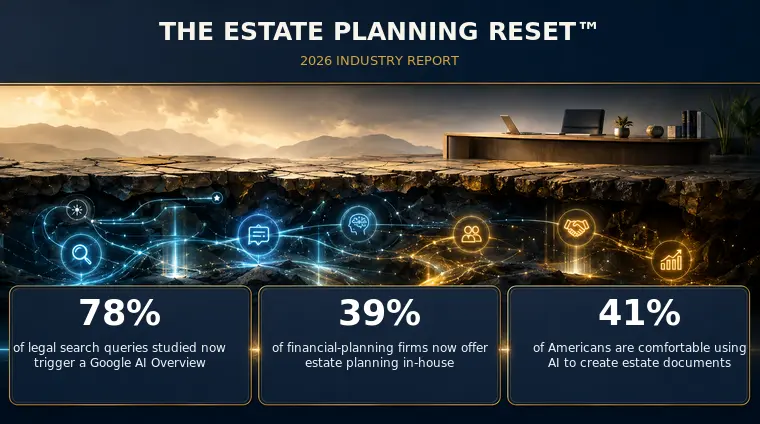
In an AI-shaped search environment, this becomes even more important. Generic content is easier than ever to produce, which means generic content is also easier than ever to ignore. AI summaries, search results, map listings, and comparison behavior all compress the first impression window. Prospects may encounter your firm quickly, but they also move on quickly when nothing signals why you are the better choice.
That is why “we need more content” is often a misdiagnosis.
Sometimes the real problem is that the firm has no clear point of view. Sometimes the messaging is too broad. Sometimes the website answers basic questions but fails to convey standards. Sometimes the follow-up sequence treats a high-trust decision like a simple transaction. Sometimes the firm is publishing often but still not giving prospects a reason to believe, “These are the people I trust with this.”
AI can accelerate those problems if nobody is paying attention.
It can help you produce more of what was already weak.
The Firms That Win Will Use AI Differently
Premium firms are not going to win by pretending AI does not exist. They are also not going to win by handing their marketing voice to a tool and hoping for the best.
They are going to win by using AI as support, not authority.
That means AI can help draft, organize, brainstorm, summarize, and pressure-test ideas. It can be useful in the hands of someone who knows what good looks like. It can save time when there is a clear strategy, a defined audience, a strong point of view, and a review process that protects the firm’s standards.
But AI should not be the final judge of what your firm says in public.
Someone still has to ask whether the content is accurate. Someone has to ask whether it reflects the way your firm actually works. Someone has to ask whether it positions your attorneys as trusted advisors or turns them into providers of downloadable documents. Someone has to ask whether the marketing helps the firm get chosen, or simply adds another polished but forgettable piece of content to the internet.
This is where attorney judgment and marketing judgment have to work together.
The attorney protects accuracy, ethics awareness, and professional responsibility. The marketing strategist protects positioning, conversion, differentiation, and the larger system that turns attention into inquiries. When either one is missing, the content may look acceptable while quietly weakening trust.
And that is the part that makes me impatient, because “acceptable” is not the standard. Not for firms doing serious work. Not in a market where AI and DIY tools are already teaching prospects to undervalue professional guidance.
Documents are easy to talk about. Judgment is harder to communicate. Your marketing has to defend that difference.
Your Marketing Should Make Attorney Value More Obvious, Not Less
Estate planning and elder law firms are already dealing with commoditization from multiple directions. DIY platforms tell consumers they can handle legal documents online. Financial advisors sometimes blur the line between planning advice and legal guidance. AI tools make people feel more informed than they may actually be.
In that environment, weak marketing does real damage.
If your website reads like a basic encyclopedia of legal topics, it unintentionally supports the idea that the work is mostly informational. If your content sounds like every other firm’s content, it reinforces the belief that any provider will do. If your AI-generated posts explain the importance of estate planning in the same pleasant, vague language everyone else uses, you are training prospects to compare on convenience, geography, and price.
That is not defending attorney value. That is quietly surrendering it.
Good marketing should make it clear that the document is not the value. The judgment behind the document is the value. The questions asked are the value. The risks prevented are the value. The ability to guide a family through decisions they do not fully understand yet is the value.
AI can help communicate that, but only if the strategy already knows it.
Otherwise, the tool will usually default to the obvious explanation, because the obvious explanation is what large language models are very good at producing. They are excellent at giving you the average answer. They are not naturally inclined to protect the premium position of a specific estate planning or elder law firm in a specific market with a specific client base and a specific growth objective.
That requires standards.
The Standard Is Not “Did AI Write This?”
I do not care very much whether AI touched a piece of content. That is becoming less and less useful as a dividing line.
The better standard is whether the content has been guided by real judgment.
Does it sound like your firm, or does it sound like a well-behaved committee? Does it clarify why your work matters, or does it simply define legal terms? Does it help the right prospect feel safer choosing you, or does it educate them just enough to keep shopping? Does it reinforce your positioning, or could it be copied and pasted onto a competitor’s website with only the firm name changed?
That last question is rude but useful.
If your content could belong to anyone, it does not strengthen your firm. It may be accurate. It may even be pleasant. But it is not doing the harder work of selection.
This is the shift I want more firms to understand. The future of legal marketing is not simply about being found in search. Being found is necessary, but it is not enough. The real advantage is being chosen after you are found. That means your digital presence has to carry the weight of trust earlier, faster, and more clearly than it used to.
AI-assisted marketing should be measured against that standard.
Not “Did we publish more?”
Not “Did this save time?”
Not even “Does this sound good?”
The better question is, “Will this make the right prospect more confident choosing us?”
If the answer is unclear, the content is not ready.
This Is Where IMS Fits
At Integrity Marketing Solutions, we work only in estate planning, elder law, and closely related probate and estate administration contexts. That focus matters because the marketing problem in this space is not generic. These firms are not selling impulse purchases. They are not selling low-stakes convenience. They are helping people make decisions that often involve fear, family dynamics, money, mortality, and long-term consequences.
That kind of marketing needs more than output.
It needs a clear strategy, disciplined execution, strong messaging, search visibility, conversion infrastructure, and follow-up that reinforces trust rather than adding noise. AI can support that system, but it should not replace the system.
Our 2026 approach is built around helping firms get chosen in an AI-shaped search environment. That means we care about visibility, yes, but we care even more about what happens after someone sees you. Do they understand why your firm is different? Do they feel safer moving forward? Does your marketing protect your professional value? Does your website, content, and follow-up make the decision easier?
That is the work.
Not chasing every tool. Not publishing for the sake of publishing. Not pretending the latest shortcut is a strategy because it came wrapped in impressive technology.
AI is powerful. It is also incomplete. The firms that understand both sides of that sentence will be in a much stronger position than the firms treating AI as either a threat to avoid or a magic wand to wave over weak marketing.
The Decision in Front of You
The practical question for your firm is not whether someone on your team can get ChatGPT to produce a blog post, an email, or an ad. Of course they can. That bar is low now.
The real question is whether your marketing has the judgment, standards, and structure to use AI without making your firm sound generic, risky, or cheap.
If you are not sure, that is worth paying attention to.
Because the risk is not always dramatic. It is often subtle. A little more sameness here. A little less authority there. A few pieces of content that do not quite reflect how your firm thinks. A website that gives information but does not create confidence. A follow-up process that stays busy but does not move people closer to trust.
That is how firms become easier to overlook.
And the firms that are easier to overlook are not always bad firms. Often, they are excellent firms whose marketing failed to communicate their value with enough clarity and discipline.
That is fixable.
If your firm is using AI in marketing, considering it, or already feeling that uncomfortable tension between efficiency and trust, this is a good moment to step back and evaluate the system around the tool.
At IMS, we help estate planning and elder law firms build marketing that supports visibility, protects attorney value, and makes the firm easier to choose. If you want a clearer view of how your current online presence is positioned for AI-shaped search and prospect decision-making, request a Discovery Call or ask about an AI-readiness and online presence review.
Not because AI is going away.
Because it is not.
And the firms that keep judgment in the process are going to be much easier to trust.
Frequently Asked Questions
1. Should estate planning and elder law firms avoid using AI in their marketing?
No. AI can be useful when it is treated as a tool, not an authority. The risk comes from using AI-generated content without strategy, review, and standards. For estate planning and elder law firms, the goal should not be to avoid AI entirely, but to make sure AI supports credible, differentiated marketing instead of producing generic content that weakens trust.
2. What is the biggest risk of AI-generated legal marketing content?
The biggest risk is that the content sounds polished enough to trust but has not been reviewed for accuracy, positioning, audience fit, or professional standards. In a trust-based practice area, confident-sounding generic content can make a firm look interchangeable, and inaccurate or poorly framed content can create reputational concerns.
3. Can AI help with SEO for estate planning firms?
AI can support SEO by helping organize ideas, draft outlines, and identify common questions, but AI alone does not create a strong estate planning marketing strategy. Search visibility still needs clear positioning, useful content, technical structure, local relevance, and conversion strategy. More AI-generated content does not automatically mean better rankings or better leads.
4. How should a law firm review AI-assisted marketing before publishing?
A firm should review AI-assisted marketing for factual accuracy, jurisdiction sensitivity, ethical concerns, brand voice, audience relevance, and conversion purpose. The content should also be evaluated for whether it helps the firm get chosen, not merely whether it sounds professional. If a piece could belong to any competitor, it probably needs more judgment before it goes live.
5. Why does generic AI content make firms less competitive?
Generic AI content tends to repeat common explanations and familiar language. That may create the appearance of activity, but it rarely builds preference. When several firms explain the same services in the same way, prospects have fewer reasons to choose one over another, which often increases price sensitivity and hesitation.
6. How can IMS help firms use AI without weakening their marketing?
IMS helps estate planning and elder law firms build marketing systems guided by strategy, standards, and practice-area expertise. That includes website messaging, SEO, content, lead capture, follow-up, and authority-building infrastructure designed to help firms become easier to choose in an AI-shaped search environment. The point is not to use AI for more output. The point is to use the right tools inside a system that protects trust and attorney value.