
A lot of attorneys are experimenting with ChatGPT right now, and I understand why. It is fast, it is easy, it is polite, and it never looks at you across the conference table and says, “I’m sorry, but that paragraph does not make any sense.” There is something very appealing about opening a blank screen, typing in a few sentences, and getting back something that sounds organized, confident, and almost embarrassingly polished.
For busy estate planning and elder law attorneys, that feels like relief. You need a blog post, an email, a social caption, a webinar title, a few ad ideas, maybe a rewrite of a page that has been sitting on your website since the year everyone thought QR codes were dead. ChatGPT gives you something. Quickly. And after years of marketing feeling slow, expensive, or unnecessarily complicated, “something quickly” can feel like progress.
The problem is that polished language is very easy to mistake for good marketing.
And those are not the same thing.
This is where many firms are getting into trouble, quietly and sometimes without realizing it. The AI output looks fine. It sounds professional. It uses the right general vocabulary. It may even include the words “estate planning,” “legacy,” “peace of mind,” “protect your family,” and all the other phrases that have been sanded smooth by overuse. Nothing screams disaster. Nothing looks obviously wrong. So it gets copied, pasted, lightly edited, and published.
Then the firm wonders why the marketing still feels flat.
Because sounding competent is not the same as creating confidence.
The Real AI Question Is Not Whether You Should Use It
I do not believe law firms should avoid AI. That would be silly, and frankly, it would be out of touch. AI can be a useful tool for brainstorming, organizing rough ideas, repurposing content, drafting first-pass outlines, and helping a busy team move faster. Used properly, it can reduce friction and help a firm maintain momentum.
But the question is not, “Should our firm use AI?”
The better question is, “What should AI be allowed to do, and what should never be delegated to it?”
That is the distinction premium firms need to make now, because AI is not just changing how content is produced. It is changing how prospects experience your firm before they ever contact you. In an AI-shaped search environment, surface-level information is everywhere. Prospects can get quick answers from search summaries, AI tools, advisor websites, DIY platforms, and every competitor in your market who is also publishing the same basic explanations.
So if your marketing becomes just another layer of generic information, you have not strengthened your authority. You have made yourself easier to overlook.
That is the irony. Many firms are using AI because they want to keep up. But when AI is used without standards, review, and positioning discipline, it can make a firm sound more like everyone else at the exact moment differentiation matters more than ever.
AI Sounds Confident, But Confidence Is Not Judgment
ChatGPT is very good at producing language that sounds complete. It is not equally good at knowing whether that language is accurate, appropriate, strategically useful, compliant with your standards, or persuasive to the kind of client you actually want to attract.
That matters in estate planning and elder law because your prospects are not shopping for casual information. They are often trying to make decisions in situations that feel emotional, unfamiliar, financially significant, and sometimes urgent. They are asking themselves, even if they do not say it out loud, “Can I trust this person with something important?”
Your marketing has to answer that question.
A generic AI-generated blog post about why estate planning matters may technically be “content,” but it may not help a prospect trust you. A social post that sounds pleasant may not make your judgment visible. A practice area page that repeats broad explanations may not show why your firm is the safer, more credible, more focused choice.
And this is where attorneys need to be especially careful. Your actual value is not that you can produce documents. Your value is judgment. Your value is risk reduction. Your value is knowing what questions to ask, what assumptions to challenge, what family dynamics matter, what tax issues could surface, what capacity concerns may exist, and when the “simple” option is not actually simple at all.
If your marketing makes you sound like a content machine instead of a professional with judgment, you are not protecting your value. You are slowly commoditizing it.
Where AI Can Help Law Firm Marketing
AI can be useful when it is working inside a clear marketing system. That is the part people skip because it is less exciting than the tool itself.
A good system defines the firm’s positioning, audience, standards, review process, claims boundaries, conversion goals, and voice before AI is ever asked to draft anything. Without that system, AI is just guessing beautifully. It may guess in the right neighborhood, but it is still guessing.
Used well, AI can help your team take a strong idea and explore angles. It can help summarize a webinar transcript into draft content. It can generate possible subject lines for a human to evaluate. It can turn a founder’s rough notes into a cleaner first draft. It can help identify places where a piece of content is too vague, too repetitive, or too bloated.
That is helpful.
But helpful is not the same as authoritative.
AI should support the thinking. It should not replace the thinking. It should make execution faster after the strategic decisions have already been made. It should not be the place where the strategy comes from, the legal nuance gets decided, or the final message is approved.
The firms that will use AI well are not the firms that ask it to do everything. They are the firms that give it a narrower job and keep professional judgment in control.
Where AI Should Not Be Trusted
AI should not be trusted to define your market position. It should not be trusted to decide what your prospects need to believe before they contact you. It should not be trusted to understand the full consequences of a legal statement, a state-specific issue, a bar-sensitive claim, or a message that accidentally creates the wrong expectation.
It should not be trusted as the final editor of anything that represents your professional judgment.
That may sound obvious, but this is exactly where the temptation creeps in. The draft sounds good enough. The team is busy. The attorney is pulled in seven directions. Nobody wants to slow down the content calendar. So the AI output gets treated as if polish equals readiness.
That is a weak standard for a premium firm.
Your clients do not hire you because you can produce words on a page. They hire you because they believe you know how to protect them from mistakes they would not see coming. Your marketing should reflect the same discipline. It should show that your firm is thoughtful, careful, experienced, and clear. Not generic. Not inflated. Not merely productive.
AI Search Raises the Standard Even More
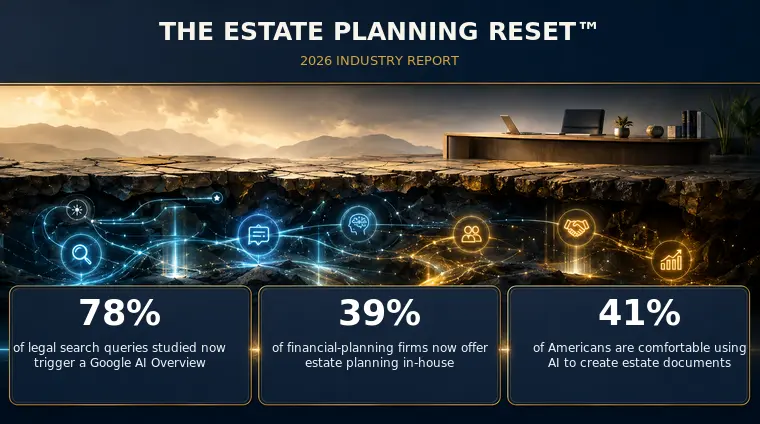
There is another layer to this, and it is becoming more important by the month. Search is no longer just a list of links. Prospects are encountering AI summaries, zero-click answers, map results, review signals, local competitors, directories, and website snippets in a compressed decision environment.
That means your content has to work harder.
Basic information is no longer enough because basic information is everywhere. If your website merely explains what a revocable trust is, or why a power of attorney matters, or when someone should update their estate plan, that may still be useful, but it is not necessarily differentiating. AI can summarize that kind of information all day long.
What AI cannot easily manufacture is your firm’s point of view. Your standards. Your way of helping people think more clearly about a risky decision. Your ability to make a prospect feel, “This firm understands what matters, and I would feel safer talking with them.”
That is selection.
Visibility may get your name in front of someone. Selection is what makes them choose you instead of the next firm.
This is why AI-generated marketing must be held to a higher standard than “does it sound okay?” The better standard is whether the content makes your firm more trusted, more specific, more credible, and more likely to be chosen by the right prospect.
If it does not do that, it is just more noise wearing a nice jacket.
Premium Firms Will Use AI With Standards
The firms that get this right will not be anti-AI. They will be anti-sloppiness.
They will decide what AI can help with and what it cannot touch without review. They will train their team to treat AI drafts as raw material, not finished work. They will require attorney review where legal accuracy, nuance, or risk is involved. They will protect their voice and positioning instead of letting the internet’s average opinion shape their message.
They will also understand that marketing is not just about publishing more. It is about creating confidence before the consultation. That requires content with judgment behind it, websites that make the firm’s value clear, follow-up that reinforces trust, and messaging that defends the role of the attorney in a market full of shortcuts.
Because that is the larger issue underneath all of this.
AI is not just a productivity tool. It is also part of the environment that is teaching consumers to believe legal answers should be instant, inexpensive, and simple. If your marketing does not actively defend the value of professional judgment, the market will happily redefine that value for you.
And I would not recommend letting the market do that unsupervised.
The Decision for Your Firm
So here is the decision in front of estate planning and elder law firms right now.
You can use AI as a shortcut to create more generic marketing faster, or you can use AI as a support tool inside a disciplined system that makes your firm’s judgment more visible.
Those are very different choices.
One makes you busier. The other makes you more credible.
One helps you publish. The other helps you get chosen.
If your firm is already using ChatGPT, or if you feel pressure to start, this is the moment to slow down just enough to put standards around it. Not because AI is bad, but because your credibility is too valuable to hand over to a tool that does not know your firm, your clients, your market, your ethics obligations, your conversion path, or the kind of trust you need to earn.
AI can assist your marketing. It can even improve parts of your execution.
But it should never be allowed to become the strategist, the attorney, or the final voice of your firm.
That job still belongs to human judgment.
And in this market, that may be the very thing your prospects most need to see.
Frequently Asked Questions
1. Should estate planning and elder law firms use ChatGPT for marketing?
Yes, law firms can use ChatGPT as a support tool for marketing, but it should not be treated as the strategist, legal reviewer, or final editor. It can help with brainstorming, outlining, repurposing, and drafting, but attorney judgment and marketing standards still need to guide what gets published.
2. What is the biggest risk of using AI-generated law firm content?
The biggest risk is assuming that polished language means the content is accurate, strategic, or trustworthy. AI-generated content can sound professional while still being too generic, incomplete, misleading, or poorly aligned with the firm’s positioning and conversion goals.
3. Can AI-generated content hurt a law firm’s credibility?
Yes, it can. If AI-generated content is vague, repetitive, inaccurate, or indistinguishable from competitor content, it can weaken trust instead of building it. For estate planning and elder law firms, credibility depends on judgment, clarity, and risk reduction, not just frequent publishing.
4. Is AI useful for law firm SEO?
AI can support parts of SEO content production, but it should not replace strategy. In an AI-shaped search environment, generic content is less likely to differentiate a firm. Strong SEO still needs clear positioning, useful content, local relevance, authority signals, and a website built to convert attention into inquiries.
5. What should attorneys personally review before publishing AI-assisted content?
Attorneys should review anything that touches legal accuracy, legal nuance, jurisdiction-specific issues, ethical considerations, client expectations, or professional claims. AI-assisted content should also be reviewed for tone, positioning, and whether it reinforces why the firm should be chosen.
6. How should a premium law firm use AI differently from a DIY marketer?
A premium firm should use AI inside a clear system, with standards for review, accuracy, positioning, and conversion. The goal is not to produce more content faster. The goal is to use AI in a way that supports authority, protects attorney value, and helps the right prospects feel confident choosing the firm.